The 56th Annual Southeastern Residency Conference will be held in-person at the Classic Center in Athens, Georgia. We look forward to seeing you all there!
Please read and follow all instructions carefully. We hope to make this a meaningful professional development opportunity for all participants.
- Registration opens February 1st.
- Resident Registration deadline is March 1st.
- Abstracts must be submitted between March 2nd and April 1st. Instructions will be emailed to all registered residents on March 2nd.
- Presentations will be live, in-person during scheduled times April 30th & May 1st at the Classic Center. Presenters must be present in their assigned room, ready to present at their scheduled time. The presenter schedule will be sent out closer to the conference.
- Moderators and Evaluators will be scheduled in each room for each session. The Moderator & Evaluator schedule will be sent out closer to the conference.
- There will be time at the end of each presentation for questions.
- Schedules and abstracts will be available via SCHED. Invitations to SCHED will be emailed out closer to the conference.
Requirements for abstracts
View sample abstracts
- You MUST be registered for the conference by March 1st. On March 2nd, I will email all registered residents with instructions on submitting abstracts. Deadline for online abstract submission and registration is 11:59pm Eastern Time on April 1.
- Content must be entered in each section prior to abstract submission.
- Check grammar, punctuation, and capitalization before final submission. Minor edits can be made to the published abstract in SCHED before the conference begins, but all edits must remain in the guidelines.
- Your abstract will not be accepted until you have paid the conference registration fees.
- The information provided will create your abstract as it will appear when published. Please adhere to the following standards:
- Title limited to 2 lines of text – short, specific titles preferred.
- Authors’ names – do not use degrees or titles.
- Choose the appropriate practice site from the drop down menu. This information will be automatically added to your final abstract (if your site is not listed, contact Elise Martin, Executive Director, by emailing sercpharm@gmail.com)
- The remaining sections must total 600 words or less (does not include title or authors) and should include:
- Background
- Methods
- Results (preliminary results are acceptable)*
- Conclusions (reached to date)*
- *If results/conclusions not available, insert “In Progress”. Update in SCHED will be required prior to the Conference.
- List e-mail of resident (or best contact) for follow-up by interested participants.
- Note: presentation objective and self-assessment question no longer required for abstract submission, but must be included in your slides presented. Slides should be uploaded to SCHED before the start of the conference.
Instructions for Abstract Submission
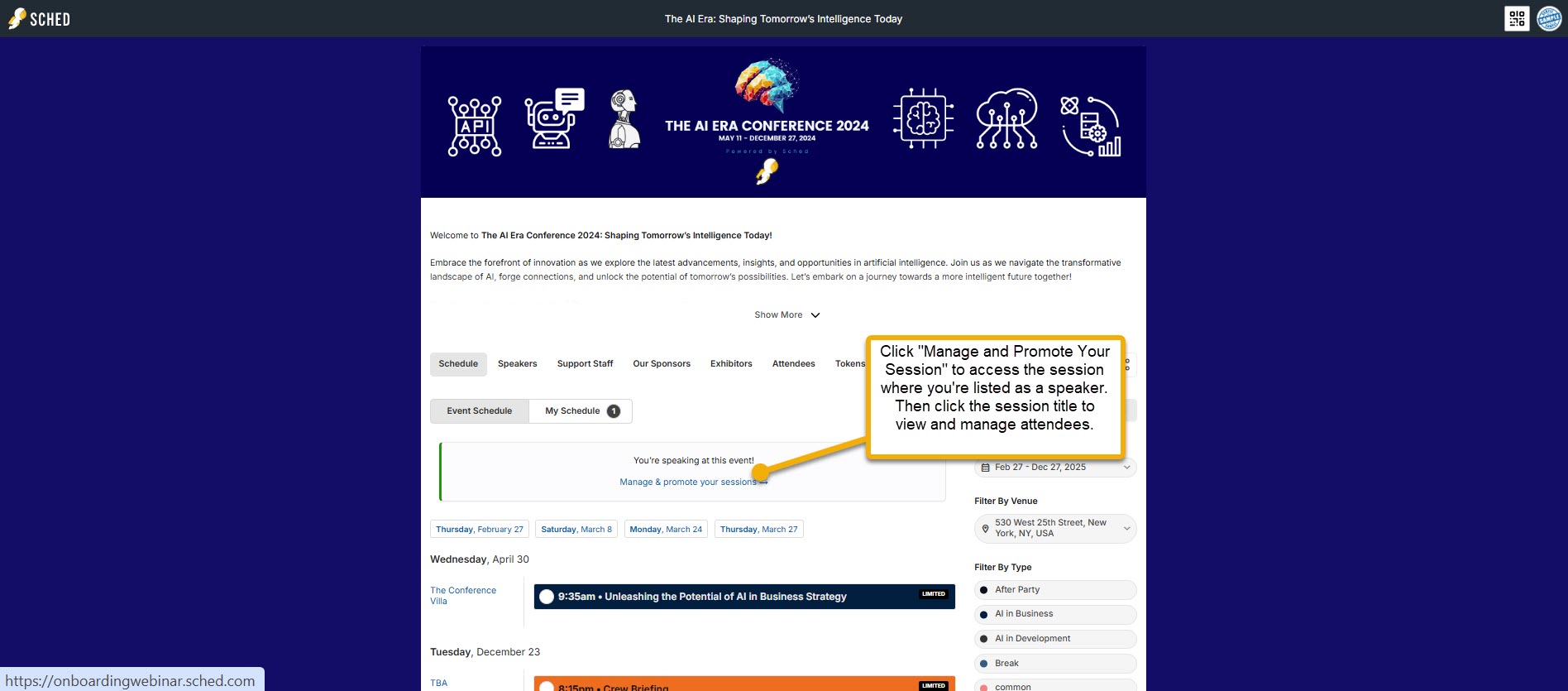
- Submit your abstract here: https://2026serc.sched.com/
- The deadline to submit abstracts is April 1st.
- Log in using the same login you used to register.
- You must register for the conference to submit an abstract.
- It is imperative you use the same email address that you used to register.
- Click Manage & Promote Session.
- Change your session title to the title of your abstract.
- Enter all abstract information into the description of your session.
- Enter abstract information using the following format. Be sure to follow all abstract guidelines on the ESC website, including character/word limits.
- Title:
- Authors:
- Objective:
- Self Assessment Question:
- Background:
- Methods:
- Results:
- Conclusion:
- Enter abstract information using the following format. Be sure to follow all abstract guidelines on the ESC website, including character/word limits.
- Save your session.
References for Presentation and Delivery
Instructions for Presenters
- Access SCHED using the email address and password you used to register.
- Assure all abstract information is correct. You may update your abstract, if needed.
- Upload a recent photo – this is very important for establishing a personal connection.
- Add a brief biography not to exceed 150 words that includes:
- 1sentence with name, credentials, and current position
- 1 or 2 sentences with education and previous training
- 1 or 2 sentences with plans for future (PGY2, other training, new job)
- 1 sentence with professional organization membership and involvement
- Upload your presentation. It is required by ACPE that we have access to a copy of your presentation. Uploading your presentation in SCHED fulfills this obligation. However, you must still bring your presentation on a USB flash drive or have access by some other means during the conference. SERC will not have your presentation ready in each room, that is the presenter’s responsibility.
- Bring your presentation to SERC on a USB flash drive or have some way to access your presentation for downloading and presenting. You may enter your scheduled room before your scheduled session to download and open your presentation. Minimize it so it will be ready to pull up during your presentation time.
Presentation evaluation process
- Assigned evaluation by Preceptors and RPDs.
- Most preceptors will be assigned to moderate or evaluate PGY1 and PGY2 presentations for 1 room for a minimum of 1 session on April 30 & May 1, 2026.
- Assigned Evaluators must submit an evaluation form for each presenter assigned to them.
- Paper evaluation forms can be found in the manilla envelope near the podium in each room.
- To claim CE, all attendees should submit an evaluation via the feedback section in SCHED for each presentation they attend. Please input as much information as possible in the comment section.
Journal articles:
-
- DeCoske MA, White SJ. Public speaking revisited: delivery, structure, and style. Am J Health Syst Pharm. 2010;67(15):1225-7.
- Vazquez SR. Publishing your residency project. Am J Health Syst Pharm. 2010;67(13)1058-9.
- McKelvey RP, Hatton RC, Kimberlin CA. Pharmacy resident project publication rates and study designs from 1981, 1991, and 2001. Am J Health Syst Pharm. 2010;67(10)830-6.
- Barletta JF. Conducting a successful residency research project. Am J Pharm Educ. 2008;72(4)92.
- Murphy JE, Downhour N. Perceived value and outcomes of residency projects. Am J Health Syst Pharm. 2001;58(10)889-95.
- Haynes RB, et al. A proposal for more informative abstracts of clinical articles. Ann Intern Med. 1987;106(4)598-604.
- Rennie D, Glass RM. Structuring abstracts to make them more informative. JAMA. 1991;266(1)116-117.
Books:
-
- Hulley SB, Cummings SR, Browner WS, editors. Designing clinical research. 3rd ed. Philadelphia (PA): Wolters Kluwer Health/Lippincott Williams & Wilkins; 2007.
- Day RA, Gastel B. How to write and publish a scientific paper. 6th ed. Santa Barbara (CA): Greenwood Publishing Group, Inc.; 2006.
Archives
For questions regarding SERC and/or the website, please contact Elise Martin, Executive Director, by emailing sercpharm@gmail.com
Need to ask a fellow resident? If so, please contact the Resident Representatives.